
Can’t lift your arm, reach behind your back, or sleep comfortably on one side? Frozen shoulder can make everyday movements painful and difficult. Frozen Shoulder Exercises can help improve mobility, but choosing the right movements is only one part of effective treatment.
Physiotherapy focuses on reducing movement limitations, improving shoulder flexibility, and helping patients return to daily activities. Through individual assessment, hands-on techniques, guided exercises, and a personalized rehabilitation plan, a physiotherapist can address the specific restrictions caused by frozen shoulder.

Frozen shoulder restricts different directions of shoulder movement, including lifting the arm and rotating it inward or outward. These limitations can affect everyday tasks and help determine which movements should be prioritized during physiotherapy.
Symptoms often progress from increasing pain to more noticeable stiffness, followed by gradual improvement in movement. The duration of each stage varies from person to person.
Physiotherapy focuses on these movement limitations. A physiotherapist assesses the shoulder’s range of motion and identifies which activities are most affected. This helps guide the selection of appropriate mobility exercises, manual therapy techniques, and a personalized rehabilitation plan.
Need Help With Pain or Recovery?
Get a personalized treatment plan from our senior physiotherapists at PhysioCare Dubai Healthcare City.
Book online or message us on WhatsApp.


Physiotherapy plays an important role in managing frozen shoulder by addressing restricted movement and helping patients return to everyday activities. Treatment is tailored to the individual’s symptoms, shoulder mobility, and tolerance for movement.
A physiotherapist can help by:
Combining professional guidance with an appropriate home exercise programme can help patients work towards better shoulder function without unnecessarily aggravating symptoms.
Learn more about available approaches on the Frozen Shoulder Treatment page.
Physiotherapy is not simply a list of exercises to perform at home. It involves assessing the shoulder, identifying movement restrictions, selecting appropriate treatment techniques, and monitoring progress.

The physiotherapist evaluates shoulder movement, pain levels, functional limitations, and relevant medical history. This helps identify which movements are restricted and establish realistic rehabilitation goals.
The findings guide decisions about exercise selection, manual therapy, and how quickly the treatment program should progress.

Manual therapy involves hands-on techniques designed to address movement restrictions. Depending on the patient’s presentation, a physiotherapist may use appropriate shoulder joint mobilization to help improve available movement.
The technique and intensity depend on pain and stiffness. Gentle approaches may be more suitable when the shoulder is highly sensitive, while movement-focused techniques may be considered when stiffness is the primary limitation.
Manual therapy is generally used alongside therapeutic exercises rather than as a replacement for active rehabilitation
Therapeutic exercises help patients work on specific movements that have become restricted. A physiotherapist can demonstrate correct technique, adjust the range of motion, and select exercises that match the patient’s current abilities.
As movement improves, the program may progress to additional mobility exercises and, when appropriate, strengthening work. This gradual approach helps patients work toward functional goals without unnecessarily stressing the shoulder.

Pain management is an important part of frozen shoulder rehabilitation. During periods of significant discomfort, treatment may prioritize tolerable movement and avoiding excessive stretching.
As symptoms change, the physiotherapist can adjust the program to address persistent stiffness and functional limitations. The aim is to make movement more manageable while supporting gradual progress.
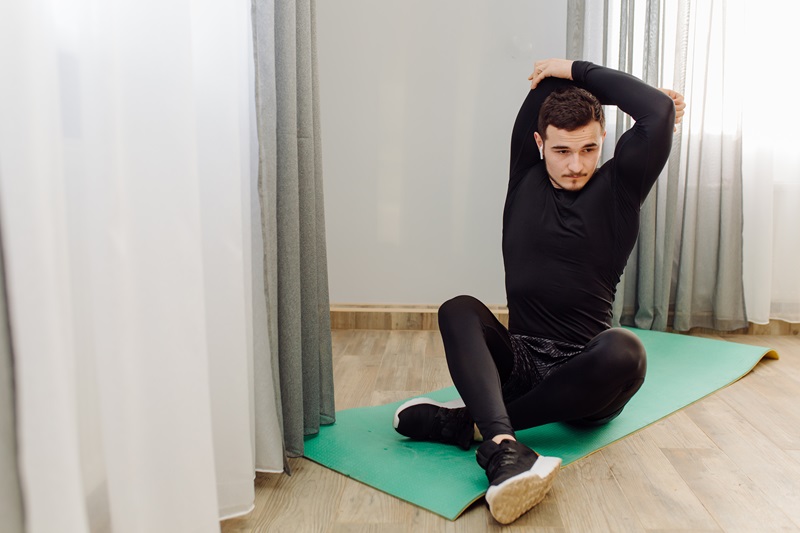
Home exercises help patients continue their rehabilitation between appointments. A physiotherapist can explain how to perform each movement, how much stretching is appropriate, and which symptoms indicate that an exercise needs adjustment.
Progress can be assessed through changes in shoulder range of motion, pain, and everyday tasks such as reaching overhead or putting on a jacket. If symptoms worsen or improvement remains limited, the treatment plan may need to be reassessed.
These exercises target different shoulder movements. They may be included in a physiotherapy program when appropriate, but not every exercise is suitable for every stage of frozen shoulder.
| Exercise | Main movement targeted |
|---|---|
| Pendulum exercise | Gentle shoulder movement |
| Towel stretch | Shoulder rotation behind the back |
| Wall walk | Raising the arm |
| Cross-body stretch | Horizontal shoulder movement |
| External rotation with a stick | Outward rotation |
| Assisted shoulder flexion | Overhead movement |
| Behind-the-back stretch | Reaching behind the body |
Lean forward with your unaffected hand supported on a table. Allow the affected arm to hang freely and gently move your body to create small forward, backward, and circular movements.
Physiotherapy focus: Introducing gentle movement when pain or stiffness makes active shoulder movement difficult.
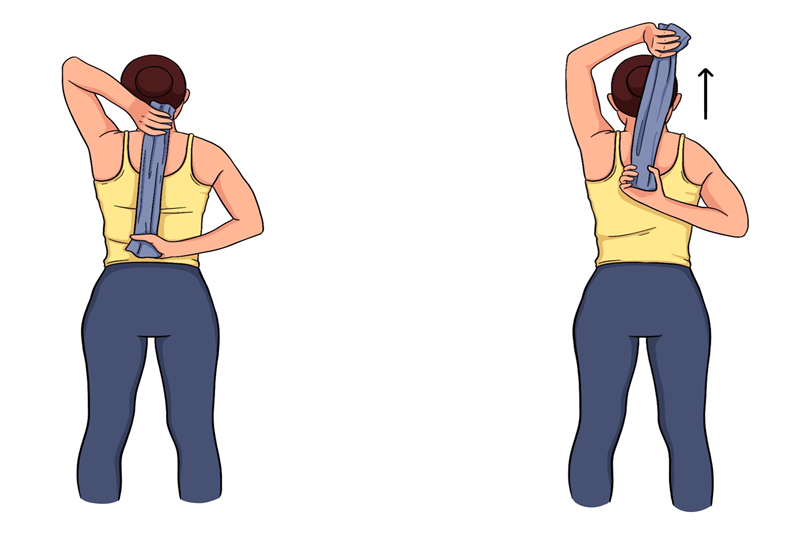
Hold a towel behind your back with one hand above the shoulder and the other below. Gently use the upper hand to guide the towel upward without forcing the affected arm.
Physiotherapy focus: Working on shoulder rotation needed for dressing and reaching behind the back.
Stand facing a wall and slowly walk the fingers of your affected arm upward. Stop at a comfortable limit, then lower your hand gradually.
Physiotherapy focus: Practising shoulder elevation while controlling the range of movement.

Bring your affected arm across your chest and use your opposite hand to support it. Gently guide the arm closer to your body while keeping the shoulder relaxed.
Physiotherapy focus: Addressing restrictions in horizontal shoulder movement when appropriate.
Hold a stick horizontally with both hands, keeping your elbows bent and close to your sides. Use your unaffected arm to gently guide the affected forearm outward.
Physiotherapy focus: Improving available external rotation, which may be limited in frozen shoulder.

Lie on your back and use your unaffected hand or a stick to assist the affected arm upward. Move overhead only as far as comfortable, then return slowly.
Physiotherapy focus: Practising arm elevation with assistance to control effort and movement.
Place your affected hand behind your back and move it upward only within a comfortable range. Use a towel for assistance only if appropriate for your symptoms.
Physiotherapy focus: Working on internal rotation and movements needed for personal care.
Stop any movement that causes sharp or severe pain. A physiotherapist can help determine the appropriate range, repetitions, and frequency for your condition.
For additional information about frozen shoulder treatment and home exercises, see the patient guidance provided by Cambridge University Hospitals NHS Foundation Trust.
Home exercises and supervised physiotherapy can complement each other, but they serve different purposes.
| Home exercises | Supervised physiotherapy |
|---|---|
| Support regular movement between appointments | Assess shoulder mobility and functional limitations |
| Reinforce prescribed exercises | Adapt treatment to pain, stiffness, and progress |
| Help maintain consistency | Provide guidance on technique and exercise progression |
| Support long-term rehabilitation | Monitor outcomes and reassess the treatment plan |
Home exercises are an important part of rehabilitation, but they may not be sufficient on their own when pain is severe, movement is substantially restricted, or the diagnosis is uncertain.

The frequency of frozen shoulder exercises depends on your pain levels, shoulder mobility, and physiotherapist’s recommendations. Gentle movements may be suitable for regular practice, while more demanding stretches may need to be adjusted.
For safer and more effective practice:
Consistent practice is important, but exercises should be adjusted to your symptoms and progress.
Consider seeing a physiotherapist if shoulder stiffness limits your daily activities, your range of motion continues to decrease, or home exercises regularly worsen your discomfort.
A physiotherapist can assess your shoulder movement, identify specific restrictions, and adapt your exercise programme to your needs. If your shoulder pain started after an injury or you are unsure of the cause, seek a professional assessment. Severe pain after an injury, visible deformity, or an inability to move your arm requires prompt medical attention.
Frozen shoulder can affect everyday activities, but a structured physiotherapy program can help address stiffness and improve shoulder function. Through individual assessment, manual therapy, guided mobility exercises, and ongoing progress monitoring, treatment can be adapted to each patient’s symptoms and movement limitations.
At Physio Care, the focus is on selecting appropriate techniques and exercises to support gradual, functional improvement. Rather than forcing painful movements, patients can work toward better mobility with a rehabilitation plan tailored to their needs.
Need Help With Pain or Recovery?
Get a personalized treatment plan from our senior physiotherapists at PhysioCare Dubai Healthcare City.
Book online or message us on WhatsApp.
Appropriate exercises can help maintain and gradually improve shoulder mobility. Their suitability and results depend on the severity of stiffness, symptoms, and stage of the condition. Physiotherapy can help select and adjust movements according to individual needs.
Yes. Physiotherapy may include individual assessment, manual therapy, joint mobilization, guided exercises, and home rehabilitation advice to help improve shoulder movement and function.
Mild stretching discomfort may occur, but exercises should not cause sharp or severe pain. If symptoms remain worse after exercise, stop or modify the movement with guidance from your physiotherapist.
There is no single best exercise for everyone. Pendulums, wall walks, assisted flexion, and external rotation target different movements. A physiotherapist can help determine which exercises are appropriate for your current mobility and symptoms.
Recovery varies and may take several months or longer. Progress depends on individual factors, and improvement is better assessed through changes in shoulder movement and everyday function than by a fixed deadline.
Frozen shoulder can make everyday movements challenging, but an individualized physiotherapy program can help address stiffness and improve functional movement over time.
At Physio Care, physiotherapy can focus on assessing movement restrictions, selecting appropriate treatment techniques, guiding therapeutic exercises, and adapting rehabilitation as symptoms change. The aim is to help patients work toward better shoulder mobility and more comfortable daily activities through a structured, individualized approach.
Prefer Physiocare.ae in Google — add us as a preferred source so our physiotherapy guides show first for you in Top Stories.

Mary Rose Estrella
Bachelor of Science in Physiotherapy — Far Eastern University–Dr. Nicanor Reyes Medical Foundation
Frozen shoulder changes over time. Understand its 4 stages, common symptoms, and how to manage pain and stiffness at each stage.
Discover 7 common causes of shoulder pain, key symptoms, and effective treatments including physiotherapy, exercises, and pain relief.

Leave a Comment